Why this matters
Longer lives are one of the great achievements of modern medicine and public health. But living longer does not automatically mean living better. A longstanding question in aging research is whether the extra years of life gained over recent decades are healthy years or whether people are simply spending more time living with chronic disease and disability. In the best-case scenario, the age at which people develop chronic diseases would rise faster than life expectancy. This would mean fewer years lived with illness, a pattern known as “compression of morbidity”.
This issue matters not only for aging individuals themselves, but also for families and health systems. If morbidity is being compressed, that is, if the onset of chronic disease is being pushed to later ages, then aging populations can remain healthy and independent for longer, reducing demand for long-term care. If morbidity is expanding, the opposite occurs: growing numbers of older adults will require sustained support, placing increasing pressure on care systems that are already under strain. Compression of morbidity is therefore desirable, as fewer years of illness mean less need for costly care.
This raises a pressing question: are the extra years being gained healthy ones, and for whom? On the first question, the evidence is mix. Medical advances have made people more likely to survive heart attacks and strokes, but the conditions behind them, such as high blood pressure or heart failure, have not declined at the same pace. Many older adults may therefore be living longer with chronic disease rather than aging without it, often with several conditions at once.
On the second question, existing research has largely treated older adults as a single group, obscuring important heterogeneities. Social inequalities in gender, occupation, migration background and age are well established predictors of health in later life, but they are rarely studied together. This is where intersectionality comes in: the idea that overlapping social positions (i.e., gender, migration background, occupational class, age) do not simply add up but interact to produce distinct health experiences. A woman who is also a migrant and works in a low-skilled occupation may face health risks that cannot be predicted from any one of these disadvantages alone. Policies based on population averages risk overlooking the groups whose health is worsening, which can widen existing inequalities and lead to underestimating future care needs. Hence, understanding which groups are benefiting from healthier aging, and which are not, is essential for designing prevention strategies that are both effective and fair.
Key Insights
We used data from the Survey of Health, Aging and Retirement in Europe (SHARE) to compare the prevalence of five major chronic conditions (i.e., heart disease, stroke, cancer, diabetes and functional limitations) among older Europeans surveyed in 2004 and in 2019/2020: two comparable samples, fifteen years apart. Using an intersectional analytical approach, we went beyond average trends to examine how these patterns varied across social strata defined by unique combinations of age, sex, migration background and occupational class.
That is, we asked whether the morbidity of a specific group is higher or lower than would be expected simply from adding up the separate effects of these characteristics. For example, do older men in high-skilled occupations with a migration background have a different rate of heart disease than their age, sex, migration background and occupational class would predict on their own?
Overall, we found no general compression of morbidity. The prevalence of all five chronic conditions was higher in 2019/2020 than in 2004, even after accounting for changes in the age and social composition of the samples. While other trends such as improved detection of chronic diseases could partly be responsible for this trend, these results are at odds with the compression of morbidity scenario and suggest that the extra years of life gained over this period have not been healthy years free of chronic disease. The overall picture masks profound inequalities, however: intersectional analyses revealed that changes in health have not been distributed equally across social strata.
- Heart disease showed the clearest signs of compression, but only in specific groups: prevalence fell by nearly 13 percentage points between 2004 and 2019/2020 among older men in high-skilled occupations with a migration background, a group that had particularly high baseline rates. By contrast, multiply disadvantaged groups such as older blue-collar low-skilled men and women showed little to no compression, with some experiencing slight increases in prevalence.
- Stroke showed no compression in any social group. Prevalence stagnated or increased across all strata, with the least favorable trend among the most disadvantaged, particularly blue-collar low-skilled men with a migration background aged 80 and over.
- Cancer showed divergent trends by sex. Prevalence expanded for most male groups, especially those in low-skilled occupations, while several advantaged female groups experienced modest declines. Growth was concentrated among the most disadvantaged men.
- Diabetes expanded across most social strata, with the steepest rises among older disadvantaged men, particularly those aged 70 and over in blue-collar occupations with a migration background. Only a small number of highly advantaged female groups showed signs of stagnation rather than growth.
- Functional limitations decreased modestly over the period, but the improvement was concentrated in relatively advantaged groups, particularly women aged 70 to 79 and men in high-skilled blue-collar occupations. Among the most disadvantaged groups, such as migrant women in low-skilled occupations aged 80 and over, rates showed no such decline and remained the highest.
How much healthier will future older people be? It depends on their social group. These findings show that progress in healthy aging has disproportionately benefited those already in advantaged social positions. Multiply advantaged groups are moving towards healthier later lives, while multiply disadvantaged groups are falling further behind: for them, the odds of aging with several conditions at once (and the functional decline and care dependency that come with it) have grown the fastest of all, in ways that population averages mask.
Policy Implications
Targeted prevention for healthy aging is already a policy priority but deciding where to target requires detailed evidence on who is being left behind. Our findings help identify where prevention efforts are likely to have the greatest impact. Accordingly, Our research points to the following priorities, against which existing prevention strategies can be reviewed:
- Target prevention at disadvantaged groups. Because health improvements are concentrated among advantaged strata, prevention efforts should prioritize groups who are not benefiting: those in low-skilled occupations, older migrants, and multiply disadvantaged men and women. Relying on population-wide campaigns may be insufficient.
- Act on diabetes urgently and universally. Unlike other conditions, diabetes expanded across virtually all social groups over the fifteen-year study period. This calls for dedicated, system-wide prevention strategies that reach beyond the most educated and health-conscious segments of the population, comprising improved access to nutritional support, physical activity programs, and early diagnosis. Preventing or delaying the onset of diabetes is one of the most effective levers available for reducing the broader chronic disease burden in later life.
- Address the social determinants of stroke. Stroke showed no compression in any social group and remained highest among the most disadvantaged. Reducing stroke risk requires addressing the upstream social conditions, that accumulate across the life course and cannot be resolved through individual behavior change alone. This includes occupational exposures, chronic stress, health behaviors such as smoking, and housing and neighborhood quality.
- Design health systems for diversity in later life. As cohorts with more diverse occupational, migration, and family histories enter older age, the heterogeneity of health needs will grow. Care systems designed around single-disease pathways are poorly equipped to manage the complex, overlapping needs that follow from these more diverse life histories. Rehabilitation programs, long-term care services and preventive health infrastructure should be designed with this diversity in mind, moving beyond one-size-fits-all approaches.
- Invest in intersectional health data and monitoring. Population-level statistics on chronic disease can mask profound subgroup divergences. Routine surveillance and health reporting systems should disaggregate data by the combination of social characteristics, not just one factor at a time, to identify population subgroups facing elevated health risks.
Population aging represents both an achievement and a challenge, but the benefits of longer life are not being shared equally. Designing public health policies that compress morbidity for all, not only the already advantaged, is a matter of both fairness and effective use of public resources for aging societies in the decades ahead.
About the Authors
Enrique Alonso-Perez is a doctoral researcher at the Charité – Universitätsmedizin Berlin and the Einstein Center Population Diversity (ECPD). He can be reached at enrique.alonsoperez@charite.de
Prof. Dr. Jan Paul Heisig is a researcher at the WZB Berlin Social Science Center, Freie Universität Berlin and the Einstein Center Population Diversity (ECPD). He can be reached at jan-paul.heisig@wzb.eu
Impressum
Publisher: Einstein Center Population Diversity
Editor: Prof. Dr. Paul Gellert
Technical coordination: Fakhriyya Shiraliyeva and Peter Weissenburger
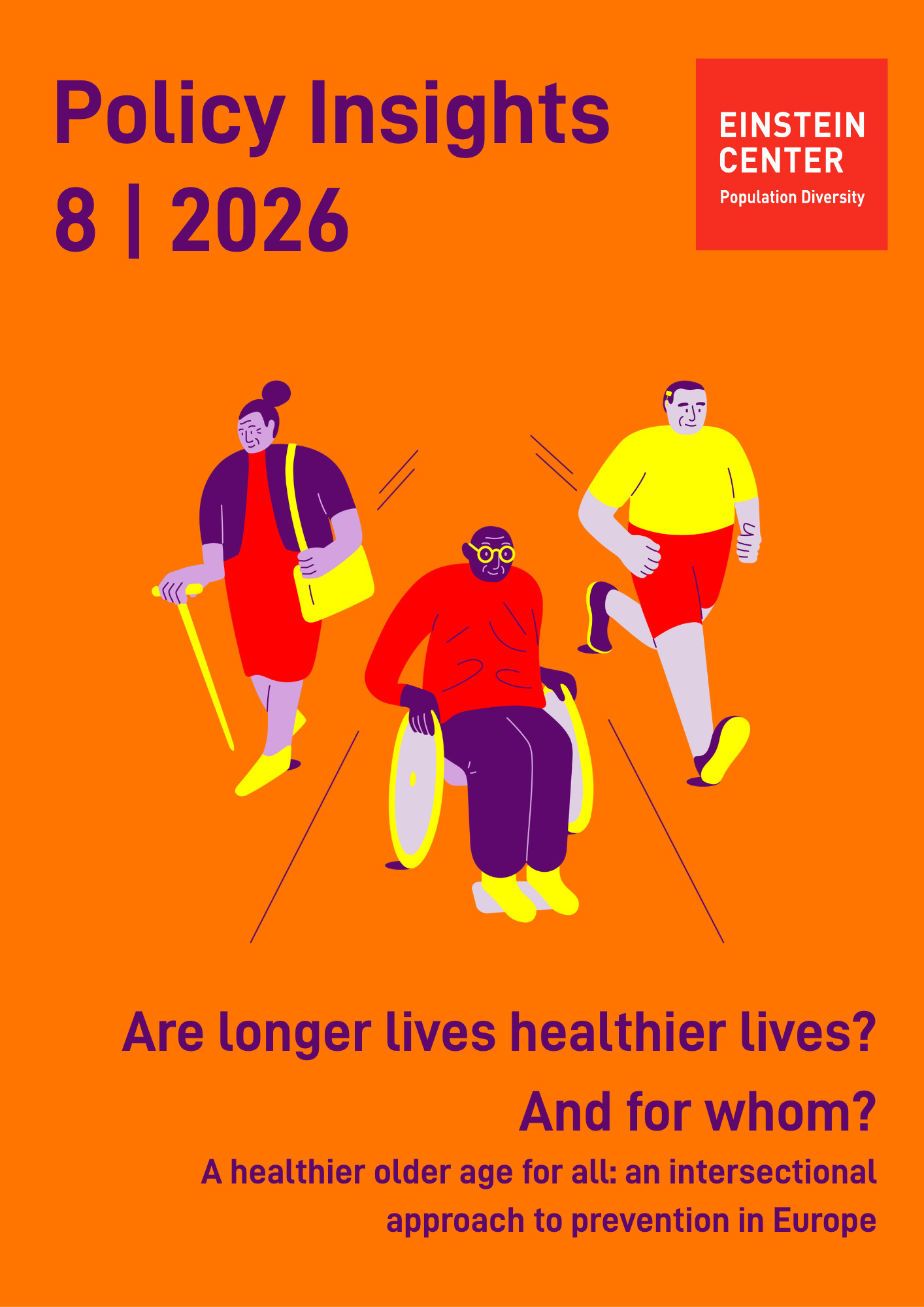
Cover image: © Illustrated by Doro Spiro.
Contact: Einstein Center Population Diversity | c/o Charité – Universitätsmedizin Berlin; Prof. Dr. Paul Gellert; Institut für Medizinische Soziologie und Rehabilitationswissenschaft; Charité – Universitätsmedizin Berlin; Charitéplatz 1; D-10117 Berlin, Germany
Email: ecpd@charite.de
Web: einstein-diversity.com
© Einstein Center Population Diversity. Contributions identified by name do not necessarily reflect the opinion of the publishers or the editors. Quotations are permitted as long as the Einstein Center Population Diversity is given credit. Articles, excerpts and graphics may only be reproduced for non-commercial purposes. Please send us a specimen copy.