Background
A “motherhood pension gap” persists across Europe, meaning that on average, mothers receive lower pensions than what women without children receive. How can this gap be closed? We present key insights from our policy evaluation of Germany’s pension-related childcare credits.
Why this matters
On average, women receive considerably lower earnings in the labour market than men, and this has implications for their retirement income. In 2024, the “gender pension gap” in the European Union was 25%, meaning that overall, women received 25% less pension income than men (Eurostat). As a result, women face a higher risk of poverty in older age, greater financial dependency on partners, and lower financial resilience.
Pension inequalities also exist among women. The “motherhood pension gap” refers to differences in pension entitlements between women with and without children. It captures the extent to which becoming a mother is associated with lower pension entitlements later in life.
The European Commission recently adopted a Gender Equality Strategy for 2026-2030 in which they set as a key objective to close the gender pension gap – specifically, “through addressing its drivers, monitoring its evolution and building on best practices”.
To contribute to the monitoring, this Policy Insight provides key take-aways from our evaluation of pension-related childcare credits – a policy in Germany that aims to strengthen pension entitlements for women with children, by recognising periods spent raising children. Introduced in 1986, these credits were part of a broader restructuring of the German pension system, which also included changes to survivor pensions. Our study aimed to understand to what extent these credits have increased mothers’ individual pension entitlements, and therefore contributed to reducing economic inequalities in later life.
Key Insights from Germany
Career interruptions associated with child-rearing are a key driver of pension inequalities in Germany. This is reflected both in the gender pension gap (GPG) – the difference in pension entitlements between women and men – as well as in the motherhood pension gap (MPG), which compares the pension entitlements between women with and without children.
In 1986, West Germany introduced pension-related childcare credits, which were later extended to the entire country after reunification. Did this policy reduce the motherhood pension gap?
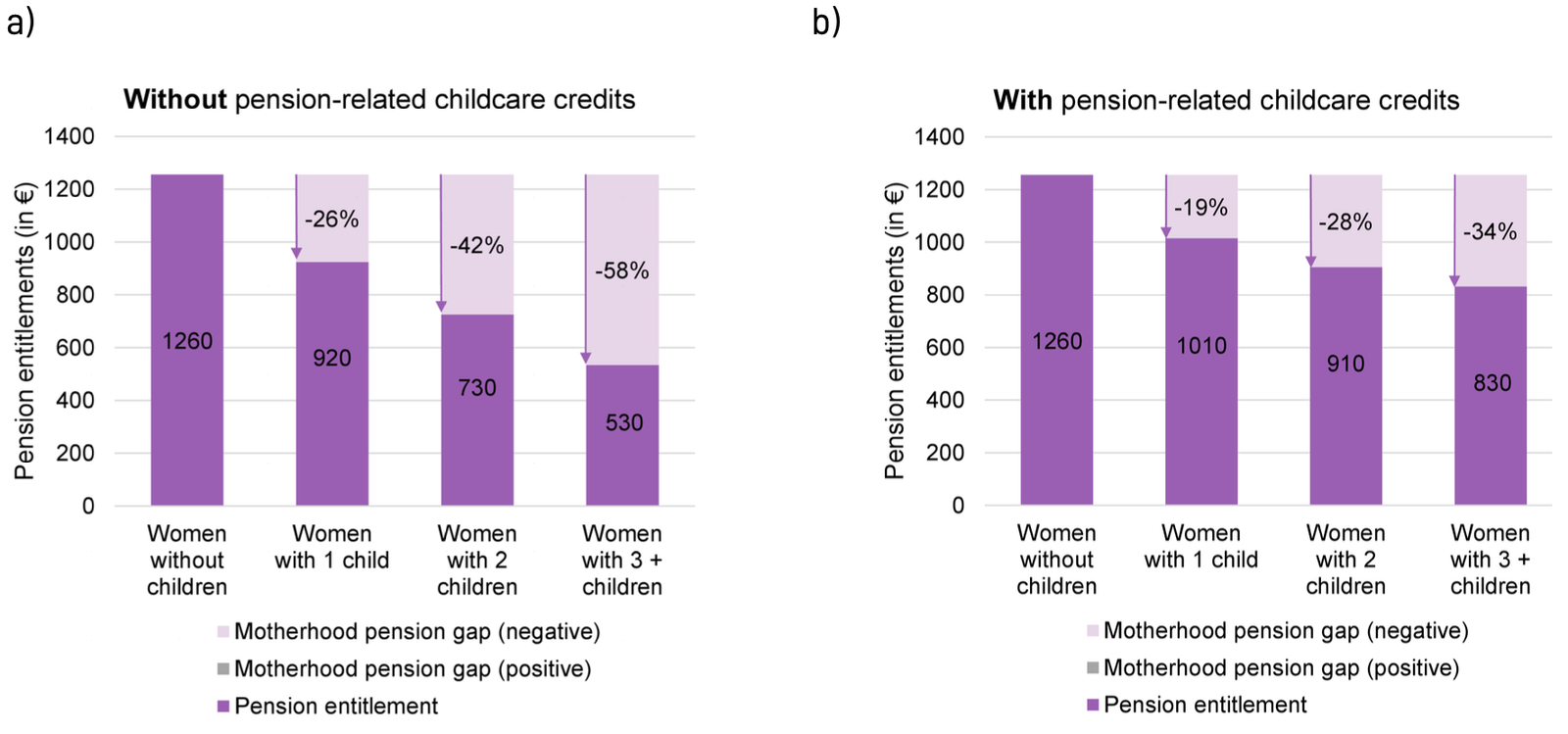
The short answer from our research is: partly. The childcare credits substantially increased pension entitlements for women with children, and therefore have reduced the motherhood pension gap in Germany. However, among those women analysed in our study (born in Germany between 1952 and 1959), women with children still receive lower pension entitlements than women without children. This “motherhood pension gap” increases with each additional child. Among West German women with three or more children, the gap reaches around 34%.
To conduct our policy analysis, we modelled an “alternative world” where women accumulated pension entitlements without childcare credits. In this scenario, women with children received pensions much lower than those of women without children. We then compared this with the “real world”, in which pension-related childcare credits are included. In the latter, the pension entitlements of women with children increased and the motherhood pension gap narrowed (see Figures 1a and 1b below).
However, our analysis also demonstrates that childcare credits do not entirely close the motherhood pension gap. The reason for this is that the policy is situated within broader structural conditions. The pension-related childcare credits in Germany cover only the first three years after a child’s birth. However, career interruptions among mothers, particularly in Western Germany, typically extend far beyond this period. As a result, the motherhood pension gap widens again after the childcare credit period ends. In Western Germany, longer employment interruptions have been common and socially accepted, with mothers often expected to rely on their husband’s pension or on later survivor benefits.
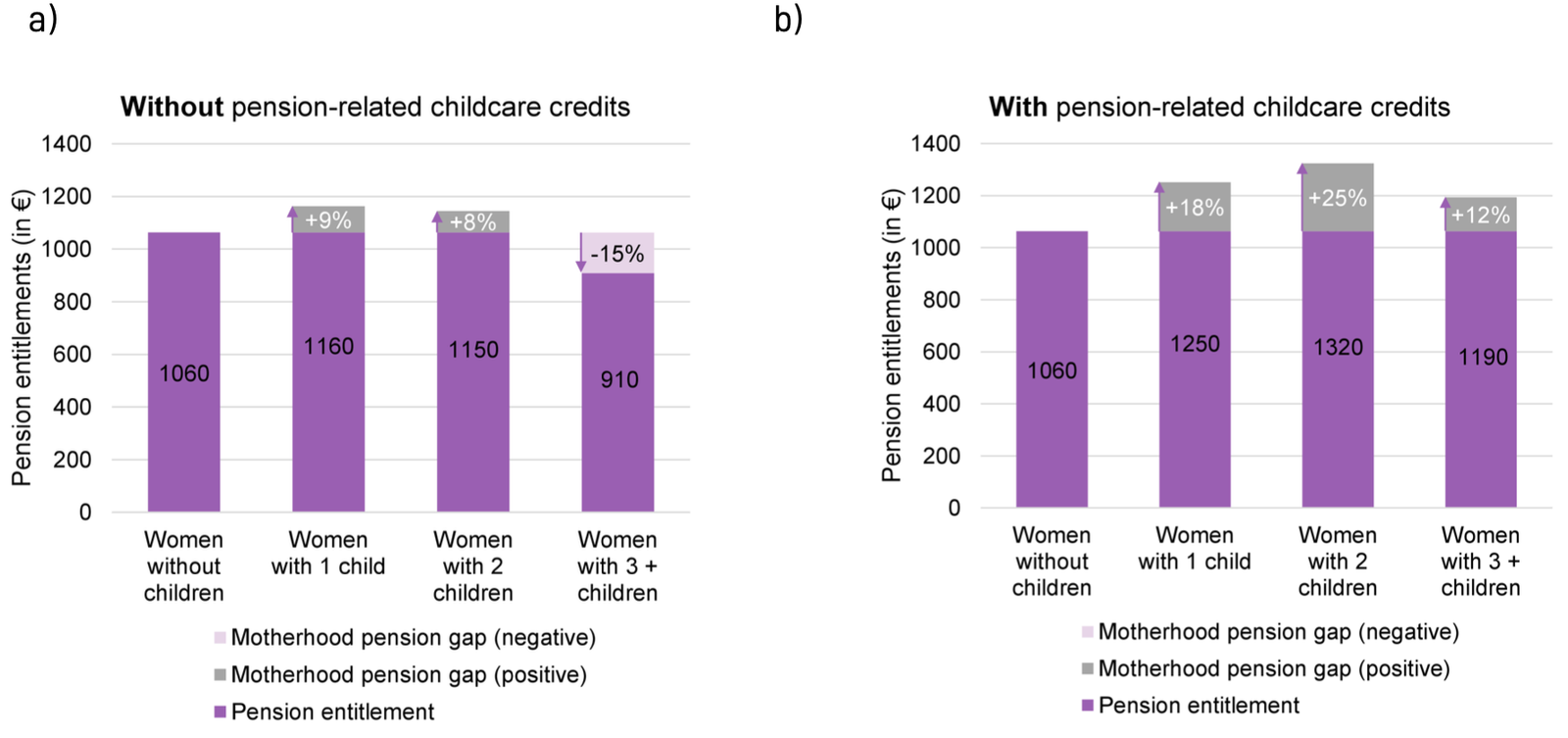
In East Germany, by contrast, broader public childcare availability, among other things, has enabled mothers to return to work relatively quickly after childbirth. Hence, even without pension-related childcare credits, there is almost no motherhood pension gap. Once they are included, all mothers, regardless of the number of children, receive higher pension entitlements than women without children (see Figures 2a and 2b below). This German case therefore illustrates how policy outcomes depend on the broader institutional context.